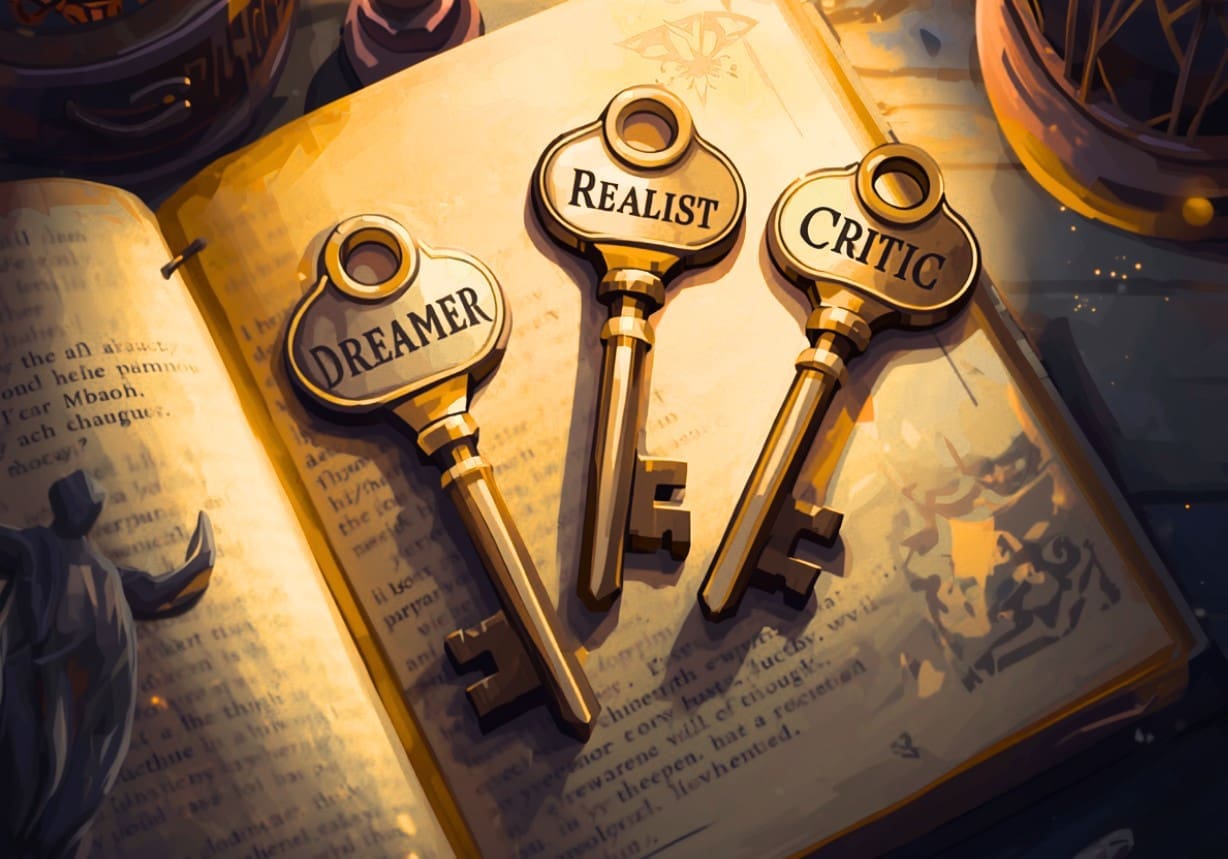

There are three creative modes every writer needs if they want to bring a book to life.
The Dreamer. The Realist. The Critic.
The problem is that most writers use them in the wrong order.
You might have a beautiful idea for a story, only for your inner critic to leap in immediately and start asking whether it is original enough, marketable enough, believable enough, clever enough, polished enough, or good enough. Or you might be sitting in front of your manuscript trying to draft, but instead of building the scene in front of you, you are still floating through possibilities, opening new doors, imagining new directions, and making it harder to choose one clear next step.
And sometimes, especially when you are revising, you might bring in the Critic with such force that it forgets its true job. Instead of helping you strengthen what is on the page, it starts tearing down your confidence as a writer.
That is where the Walt Disney Strategy can be so powerful for writers.
It gives you a way to separate the different parts of your creative process, so your imagination, practical planning, and critical thinking can each do their work at the right time.
What Is the Walt Disney Strategy?
The Walt Disney Strategy is an NLP-based creative process modelled by Robert Dilts in 1994, based on the way Walt Disney was said to work creatively. Disney’s co-workers famously observed that there seemed to be three different Walts: the Dreamer, the Realist, and the Critic.
What Dilts recognised was that Disney had a way of separating three different thinking modes. He could dream expansively, then build practically, then evaluate constructively, without letting one mode interfere too early with another.
For writers, this matters enormously.
Writing a book asks you to imagine something that does not yet exist. It asks you to turn that imagined thing into actual pages. Then it asks you to examine those pages and make them stronger.
Those are three very different tasks. They require different internal states, different questions, and different kinds of focus.
When you understand which mode you are in, and which mode you actually need, the writing process becomes much clearer.
The Dreamer: Where the Story Is Allowed to Breathe
The Dreamer is the imagination phase.
This is where the story first opens. It is where characters begin speaking in your mind, where strange little images arrive, where a scene appears while you are washing dishes, driving, walking, or lying awake at night.
The Dreamer asks: what could this be?
In the Dreamer phase, you give yourself permission to explore without needing to justify the idea yet. You allow the big what-if questions. You let your characters surprise you. You let the story wander a little. You let images, fragments, possibilities, themes, lines of dialogue, and emotional truths come forward without asking them to prove themselves immediately.
This is the phase many writers secretly love most, because it feels alive. It is spacious, open, exciting, and full of possibility.
But the Dreamer needs protection.
If the Critic enters too early, it shuts the Dreamer down. It starts asking whether the idea is strong enough before the idea has had a chance to become anything. It judges the seed before the roots have formed.
That is why so many writers abandon ideas before they have even begun writing them. The idea arrives, the Dreamer lights up, and then the Critic walks straight into the room and starts cross-examining it.
Instead, when you are in Dreamer mode, your job is simple: allow the story to show you what it wants to become.
You are not planning it yet. You are not fixing it yet. You are not refining it yet. You are simply listening.
A Simple Dreamer Practice for Writers
Before you begin a new idea, scene, chapter, or section, take a few moments to enter your Dreamer space.
Close your eyes if that feels comfortable, soften your shoulders, and imagine stepping into a room that belongs entirely to your imagination. It might be full of light, books, windows, colour, music, candles, art, or open sky. It might be quiet and intimate, like a writing nook created just for you.
Bring your book to mind and ask:
What could this be if I gave it room?
Let images come. Let scenes appear. Let the story move in directions you may not have expected. Let your character do something surprising. Let the book show you something before you decide what it means.
The Dreamer does not need a finished answer. The Dreamer needs space.
The Realist: Where the Dream Becomes Pages
The Realist is where the dream becomes real.
This is the plotting, planning, organising, drafting, decision-making part of the process. It is the part that takes the beautiful, shimmering possibility from the Dreamer and asks: how do we build this?
Many writers misunderstand the Realist. They think the Realist is the boring one, the cautious one, the part that limits the dream.
But the Realist is not a smaller version of the Dreamer. The Realist is the part of you that loves the dream enough to give it structure.
The Realist understands that a book cannot stay in the realm of ideas forever. At some point, the story needs chapters. Scenes. Turning points. Sentences. Pages. A writing rhythm. A next step.
The Realist asks practical questions:
What needs to happen next? What does this scene need to accomplish? What does the reader need to understand here? What decision does this character need to make? What structure would help this idea hold together? What is the next piece I can build today?
This is the mode that actually writes the book.
And for many writers, this is the missing bridge.
They dream up the idea, then jump straight into criticising it. They never give the Realist time to create a plan, a scene, a draft, or a rough version that can later be shaped.
That is such an important distinction.
Your Critic cannot refine what your Realist has not yet built.
A concept is not a book. A premise is not a manuscript. A beautiful idea still needs a pathway onto the page.
That is the Realist’s work.
A Simple Realist Practice for Writers
When you feel scattered, overwhelmed, or unsure where to begin, step into the Realist room.
Imagine this space as a workshop. There might be a desk, notebooks, index cards, a whiteboard, a laptop, a wall covered in story beats, or simply a clean surface with one clear page in front of you.
This room has purpose. It has movement. It has the feeling of, “Right, let’s build this.”
Bring your manuscript to mind and ask:
What is the next practical step?
That question is powerful because it pulls you out of the fog. You are not trying to solve the entire book at once. You are asking what the next buildable piece is.
Maybe the next step is outlining the next three scenes. Maybe it is writing the messy version of a chapter. Maybe it is clarifying what your protagonist wants in this moment. Maybe it is deciding the order of your ideas in a non-fiction chapter. Maybe it is opening the document and writing for twenty minutes.
The Realist does not require certainty about the entire journey. The Realist asks you to build one piece at a time.
The Critic: Where the Work Becomes Stronger
The Critic is the refinement phase.
This is where many writers feel the most tension, because the word “critic” can carry so much weight. It can sound harsh, judgemental, and unsafe.
But in the Walt Disney Strategy, the Critic is not there to destroy the work. The Critic is there to strengthen it.
Used well, the Critic is one of the most valuable parts of your creative process. It helps you see what is working, what is missing, what needs deepening, what needs cutting, and what would make the manuscript clearer, stronger, and more emotionally satisfying.
The key is timing.
The Critic belongs third.
After the Dreamer has imagined. After the Realist has built. Then the Critic can come in and refine.
When the Critic arrives too early, it blocks creation. When it arrives at the right time, it becomes a powerful ally.
A healthy Critic asks questions, not verdicts.
Instead of saying, “This is terrible,” it asks, “What does this scene still need?”
Instead of saying, “This book is a mess,” it asks, “Where is the structure unclear?”
Instead of saying, “You are not good enough,” it asks, “What would make this chapter stronger?”
That is the difference between an inner critic that attacks your identity and a constructive Critic that serves the manuscript.
One makes you want to close the laptop. The other helps you keep going.
A Simple Critic Practice for Writers
When you are ready to revise, imagine stepping into the Critic’s room deliberately.
This matters. You are choosing to enter. You are not being dragged there by anxiety, self-doubt, perfectionism, or panic. You are deciding that this is the right time to look at the work with clear, constructive eyes.
Before you begin, remind yourself:
The Critic is here to strengthen what I have built.
Then ask:
What is working here? What needs more clarity? What needs more emotional depth? What feels thin, rushed, or underdeveloped? What would make this scene, chapter, or section stronger?
Notice the tone of those questions. They are specific. They are useful. They are focused on the work, not your worth.
That is what makes the Critic safe to use.
Why the Order Matters So Much
The sequence is always Dreamer first, Realist second, Critic third.
Dreamer, Realist, Critic.
Idea, build, refine.
When you use them in that order, each mode supports the next. The Dreamer brings possibility. The Realist turns possibility into something tangible. The Critic improves what has been created.
But when the order gets scrambled, the writing process becomes painful.
If the Critic interrupts the Dreamer, you shut down ideas before they have had a chance to become anything. If the Dreamer keeps running while the Realist is trying to draft, you can end up chasing possibilities instead of writing pages. If the Critic arrives while the Realist is still building, you may start editing every sentence before the scene has even found its shape.
None of this means something is wrong with you as a writer.
It means the wrong internal mode may be trying to do the wrong job.
And once you can see that, you can change it.
Ask Yourself: Which Room Do I Need Today?
Before your next writing session, pause for a moment and ask yourself:
Which room do I need to step into today?
If you are brainstorming, exploring, dreaming into a new idea, or reconnecting with the heart of your story, you may need the Dreamer.
If you are drafting, outlining, planning, or trying to turn the idea into pages, you may need the Realist.
If you are revising, strengthening, cutting, deepening, or polishing, you may need the Critic.
And if you notice you are in the wrong room, you can gently shift.
You can close the Critic’s door when it tries to walk into the Dreamer’s space. You can thank the Dreamer for the ideas and then invite the Realist to choose a path. You can ask the Critic to wait until there is something on the page worth refining.
That kind of internal awareness changes the way you write.
Because the aim is not to silence any part of your creative process. The aim is to let each part do the job it is designed to do.
You Already Have All Three Modes Inside You
You have a Dreamer inside you. That is the part that sees possibility, feels the pull of the story, and imagines what could exist.
You have a Realist inside you. That is the part that can build the bridge, make the plan, write the scene, and take the next practical step.
You have a Critic inside you. That is the part that can help you refine, strengthen, clarify, and elevate the work once it is ready.
You do not need to become a different kind of writer to use this strategy. You simply need to notice which part of your creative mind is active, which part is needed, and whether they are showing up in the right order.
Give your Dreamer room.
Trust your Realist to build.
Invite your Critic in when the work is ready.
And remember, you are the vessel for the story. Let the words flow through you and onto the page.
Listen to the Related Podcast Episode
This blog is based on the Write The Darn Book podcast episode, The Walt Disney Strategy for Writers Part 2: Three Guided Visualisations to Access Your Dreamer, Realist, and Critic.
You can listen to the full episode on Apple Podcasts here: https://podcasts.apple.com/us/podcast/write-the-darn-book-beat-writers-block/id1858775581
Want to Understand Your Own Writing Process More Deeply?
If this helped you realise that your writing process might need more than willpower, and that your creative mind may simply need the right doorway in, you’ll love my Writing Personality Blueprint Sessions.
In this personalised one-to-one session, we uncover how you’re uniquely wired to write, what may be creating resistance, and the practical tools that can help you move forward with more clarity, confidence, and flow.
You can learn more at https://maddisonmichaels.com/blueprint.


