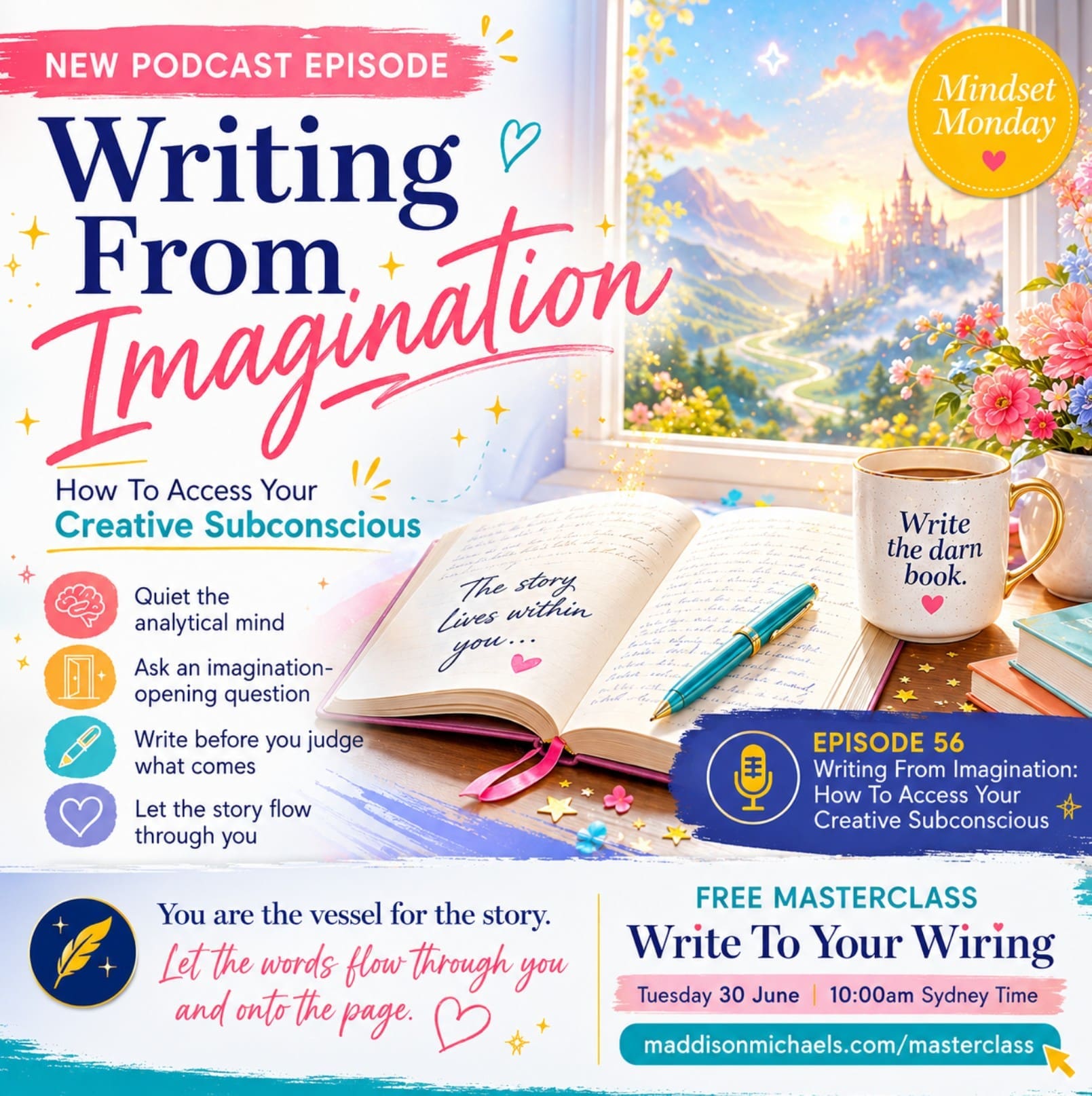

Mindset Monday episodes explore the inner work of writing: blocks, beliefs, identity, resistance, procrastination, perfectionism, and creative flow.
Have you ever written something and afterwards thought, I have no idea where that came from?
A line of dialogue arrives fully formed. A character does something you didn’t plan. A scene suddenly turns in a direction that feels more alive than anything you could have carefully outlined. And for a moment, writing doesn’t feel like forcing words onto the page. It feels like receiving something. Following something. Listening to something deeper than the busy, analytical part of your mind.
That is the place so many writers are longing to return to.
Because some of your best writing will not come from trying harder. It will not come from mentally gripping the scene, forcing the perfect sentence, or demanding your brain explain every step before you begin. Some of your best writing comes when you quiet the part of you that wants to control everything and access the deeper imaginative layer of your mind.
That is where image, memory, story, emotion, intuition, character, and language begin to meet.
Writing from imagination is not vague inspiration. It is not waiting around for the muse to descend. It is a practical, repeatable way of entering the story before you write, so you can stop hovering above the manuscript and start stepping into it.
If your writing has been technically correct but not alive, or you keep thinking about the scene instead of actually entering it, this is where I want you to begin.
The Difference Between Writing From Your Head and Writing From Your Imagination
There is a big difference between writing from mental pressure and writing from true imagination.
Writing from your head often feels like standing outside the story with a clipboard. You are observing it, assessing it, and trying to make it behave. You might be asking questions like, what should happen next? Is this good enough? Am I doing this properly?
Those questions are not wrong. Structure has a place. Craft has a place. Discernment has a place. But when those questions start running too early in the writing process, they can pull you out of immersion and into analysis.
Writing from imagination feels different.
It feels like stepping through a doorway and entering the story world from the inside. You are not only deciding what the character says. You are hearing how they say it. You are not only choosing the setting. You are noticing the light in the room, the texture of the chair, the thing your character wants to admit but cannot quite say aloud.
You are not pushing the scene from behind. You are walking into it and allowing it to reveal itself to you.
That is the creative subconscious at work.
When you are truly inside the story, you are not only thinking. You are listening. You are receiving. And this is where writing becomes more than a mental exercise. It becomes a relationship between your conscious craft and the deeper story wisdom that lives beneath the surface.
This is what I mean when I say: you are the vessel for the story. Let the words flow through you and onto the page.
You still bring your craft. You still bring your lived experience. You still bring your judgement, skill, and discernment. But you are not the entire source of the story. You are the channel it moves through.
Why Your Creative Subconscious Matters
When I talk about the creative subconscious, I am not talking about something airy-fairy or impossible to use in a practical way. I am talking about the deeper pattern-making part of your mind.
It is the part of you that stores memory, emotion, story instinct, and lived experience. It is the part that has absorbed a lifetime of reading, imagining, noticing, feeling, and connecting meaning.
Your conscious mind can only hold a small number of things at once. That is why writing can feel so overwhelming when you are trying to keep the plot, character motivation, emotional arc, scene purpose, dialogue, pacing, and prose quality in your head at the same time.
It is too much.
Your conscious mind starts clenching, and suddenly the story feels like a puzzle you are failing to solve.
But your creative subconscious is wider than that. It can connect things in the background. It can bring forward images before you know what they mean. It can offer a line of dialogue that reveals a character more clearly than three paragraphs of analysis.
The problem is that many writers have accidentally trained themselves to distrust it.
We have been taught to value control, planning, productivity, and getting it right. And yes, those things matter at certain stages. But if you only ever write from control, you can cut yourself off from the part of your mind that makes the writing feel alive.
Different Writers Access Imagination Differently
This is where creative wiring matters.
Some writers naturally access imagination through images. Some hear the scene. Some feel it in the body. Some need the right question before the deeper answer can come forward.
Visual, Auditory, Kinesthetic, and Auditory Digital writers can all access the creative subconscious, but they often need different doorways.
A Visual writer might need to see the room before the words come. An Auditory writer might need to hear one line of dialogue. A Kinesthetic writer might need to feel the emotional tension in the body. An Auditory Digital writer might need the right question, something precise enough for the analytical mind to relax and hand the scene over to the imagination.
Your Bird Writing Personality can show up here too.
If you tend toward Dove, you may access emotional truth beautifully, but pull back if the writing feels too vulnerable. If you tend toward Owl, you might get stuck trying to understand the scene before you let yourself write it. If you tend toward Peacock, you might receive vivid ideas quickly, but need a gentle container so the imagination does not scatter into ten new directions. If you tend toward Eagle, you might push for momentum so hard that you skip the quieter imaginative signals.
These are tendencies, not fixed boxes. But they help explain why writing from imagination can feel effortless for one writer and strangely unsafe for another.
For some writers, imagination feels like freedom. For others, it can feel like losing control.
So the shift is not about throwing away structure or abandoning craft. It is about letting the deeper creative mind come forward first, then allowing the analytical mind to support it afterwards.
When a Scene Feels Wooden, It May Need Imagination Before Analysis
I have felt this difference so clearly in my own writing.
There have been chapters where, on paper, I had everything I needed. I knew the purpose of the scene. I knew where it sat in the manuscript. I understood the external goals. I knew what needed to be revealed.
But when I sat down to write, the scene felt wooden.
The sentences were there, but there was no pulse in them. I was moving the characters around like chess pieces. He says this. She reacts. This happens next. It technically made sense, but it did not feel like anyone was truly alive inside the scene.
And the more I tried to fix it from my head, the worse it became.
I kept asking logical questions. What is the scene goal? What is the conflict? What needs to be revealed? And those are useful questions, but I was using them at the wrong moment. I was trying to build the emotional life of the scene from the outside in.
Eventually, I stopped.
Instead of asking, what should happen in this chapter, I asked a different question.
What is actually alive here?
That was the doorway.
I stopped trying to control the mechanics of the scene and allowed myself to feel into it. I imagined the room. I noticed where the characters were standing. I let myself sense what was not being said. I stopped trying to write the scene correctly and started listening for the emotional truth underneath it.
And suddenly, the chapter changed.
A character said something I had not planned. It was not a dramatic speech. It was one sentence. But that one sentence shifted the emotional current of the whole scene. It revealed a wound I had not fully understood yet. It changed the energy between the characters. It gave the scene a reason to exist beyond plot mechanics.
That is what writers often mean when we say a chapter wrote itself.
We do not literally mean we had nothing to do with it. We mean we stopped blocking the deeper creative process. We got out of the way enough for the story to move through us.
Receiving the story does not mean you sit back and do nothing. It does not mean you abandon craft or wait passively for inspiration. It means you stop gripping so tightly. You stop treating the story as something you have to dominate, and you begin treating it as something you are in relationship with.
That is where faith, intuition, and creative trust often meet.
Whether you call that God, intuition, consciousness, or the deeper wisdom of your own subconscious, there is a part of the creative process that asks for trust. There is still revision. There is still craft. There is still discernment. But the source of the writing feels different.
It becomes less like dragging something out of yourself and more like opening a channel to something that was waiting beneath the noise.
The Imagination Doorway Practice
You can train your mind to enter the imaginative state more reliably.
You do not have to sit around waiting for inspiration. You do not have to hope the muse turns up. You can create conditions that tell your nervous system, your imagination, and your creative subconscious that it is safe to come forward.
This begins with a transition.
Most writers make the mistake of moving straight from ordinary life into the manuscript. They go from emails, life admin, decision fatigue, and everyday noise straight into the document, then wonder why their imagination does not instantly open.
But your creative mind needs a doorway.
You need a small ritual that moves you from the surface mind into the story mind. It does not need to be complicated. In fact, if it is too complicated, you probably will not do it.
The Imagination Doorway Practice has three simple parts.
First, Quiet the Analytical Brain
Before you open the manuscript, take one minute to physically settle.
Put your feet on the floor. Let your shoulders drop. Take a slow breath in, then a longer breath out. You are not trying to become perfectly calm. You are simply letting your body know there is no emergency here.
The page is not a threat. The story is not a test. You are safe to enter it.
This matters because when your nervous system is activated, your analytical brain often gets louder. It wants certainty. It wants control. It wants to protect you from judgement, failure, or wasted effort.
Rather than fighting that part of you, reassure it.
You might say to yourself: I am not here to get this perfect. I am here to enter the story.
Or you might use the phrase that sits at the heart of my own writing practice:
I am the vessel for the story. The words flow through me and onto the page.
That phrase is not about handing away responsibility. It is about releasing the pressure that says everything must come from effort, control, and conscious force. It reminds your nervous system that you do not have to wrestle the book into existence.
You can soften. You can listen. You can allow.
Then, Ask an Imagination-Opening Question
Once your body has settled, ask one question that invites the subconscious to bring something forward.
This is not a controlling question like, how do I make this scene brilliant? That question will send most writers straight into pressure.
Ask a question that opens a door.
You might ask: what is alive in this scene? What does my character already know but refuse to say? What does the reader need to feel here?
Choose one question. Only one. The goal is not to interrogate the scene. The goal is to invite the first thread to appear.
Then close your eyes, or soften your gaze, and let an image, sound, feeling, or sentence arise. Do not force it. Let it arrive in the way your mind naturally works.
If you are Visual, ask yourself what you can see. Look for the first image: the doorway, the weather, the object on the table, the expression on your character’s face.
If you are Auditory, listen for the first sound in the scene. A voice. Footsteps. Silence. The rhythm of the room.
If you are Kinesthetic, feel for the emotional temperature. Is there tension in the chest? Dread? Relief? A pressure between two characters?
If you are Auditory Digital, ask a precise question and let the answer come without debating it. What is the function of this scene? What truth is being revealed? What decision changes because of this moment?
Once your analytical mind has a clear doorway, it can often relax enough for the imagination to move.
Finally, Write Before You Judge
This is where the practice either works or collapses.
Because if you receive an image, line, feeling, or impression and immediately judge it, you close the door again. The analytical mind jumps back in and asks: is that good? Does that make sense? Is that the right place to start?
For the first ten minutes, your job is to follow.
Write the image. Write the line. Write the feeling. Write the clumsy first sentence if that is what comes. Begin anywhere. You can shape it later. You can revise later. You can bring craft back in later.
But at the beginning, your task is to let the words come through before you start measuring them.
This is the part so many writers miss. They want the subconscious to speak, but they keep interrupting it.
Your imagination is not a machine. It is responsive. It comes forward when it senses welcome, curiosity, and enough safety to be imperfect.
So when something comes, receive it. Write it down. Follow it for ten minutes before you decide what it means.
Over time, this becomes an anchor.
Feet on the floor. Breath. Doorway question. Ten minutes of following before judging.
Your system learns: this is how we enter the story.
Writing From Imagination Will Not Make Every Session Magical
This practice will not make every writing session magical. Some sessions will still be messy. Some scenes will still need structure. Some days you will access only the tiniest thread.
That is okay.
The goal is not to create a dramatic creative breakthrough every time. The goal is to stop approaching the manuscript like a problem to solve and begin approaching it like a world you can enter.
That shift changes everything.
When you write from imagination, your manuscript begins to carry more life. The descriptions become more specific. The dialogue feels less manufactured. The emotional beats deepen. And perhaps most importantly, you begin to trust that there is more inside you than what your analytical mind can immediately explain.
That trust is a writer’s gold.
It allows you to keep going when the next step is not perfectly clear. It lets you draft a scene before you know every detail. It helps you stay open to the book becoming richer than the version you planned.
Sometimes the next scene does not need more thinking. Sometimes it needs a question, a breath, and enough quiet for the deeper story to answer.
Try One Imagination-Led Writing Session This Week
This week, choose one writing session and make it imagination-led.
Not performance-led. Not productivity-led. Not prove-you-are-a-real-writer-led.
Imagination-led.
Before you open the manuscript, take one minute to settle your body. Then ask one doorway question: what is alive in this scene? What does my character already know but refuse to say? What does the reader need to feel here?
Let the first impression arrive in whatever way your mind gives it to you. Image, sound, feeling, or sentence. Whatever comes, write from there for ten minutes without judging it.
Just ten minutes.
If part of you thinks, but what if it is bad? Let it be bad for ten minutes. Bad writing can be shaped. Blank pages cannot be edited.
The point of this practice is not to produce perfect prose. It is to reopen the channel between you and the deeper imaginative layer of your story.
Your book is not only built through planning. It is built through listening. It is built through trust. It is built through learning how to become available to the story.
You are not here to be a machine. You are here to become a clear, steady, trusted vessel for the story that has chosen you.
So begin with this:
I am the vessel for the story. The words flow through me and onto the page.
Then breathe. Ask your doorway question. Listen for what comes. And write from there.
Free Masterclass: Write To Your Wiring
If this has made you curious about the way your mind naturally accesses story, imagination, and creative momentum, I would love to invite you to my free masterclass, Write To Your Wiring.
It is happening on Tuesday 30 June at 10:00am Sydney Time, and I will walk you through the NLP writing modalities and show you how they shape the way you write. We will look at how Visual and Auditory writers access story, how Kinesthetic writers write through feeling, and how Auditory Digital writers use structure and language to create.
You will begin to understand why certain writing advice works beautifully for one writer and completely fails another, and how to build a writing process that fits the way your mind actually works.
And if you cannot attend at the scheduled time, register anyway, because everyone who registers will be sent the replay.
Listen to the Podcast
This article is based on Episode 56 of the Write The Darn Book podcast: Writing From Imagination: How To Access Your Creative Subconscious.
If you would love to hear the full conversation in Maddison’s voice, you can listen to the episode on the podcast.
And remember, you are the vessel for the story. Let the words flow through you and onto the page.


