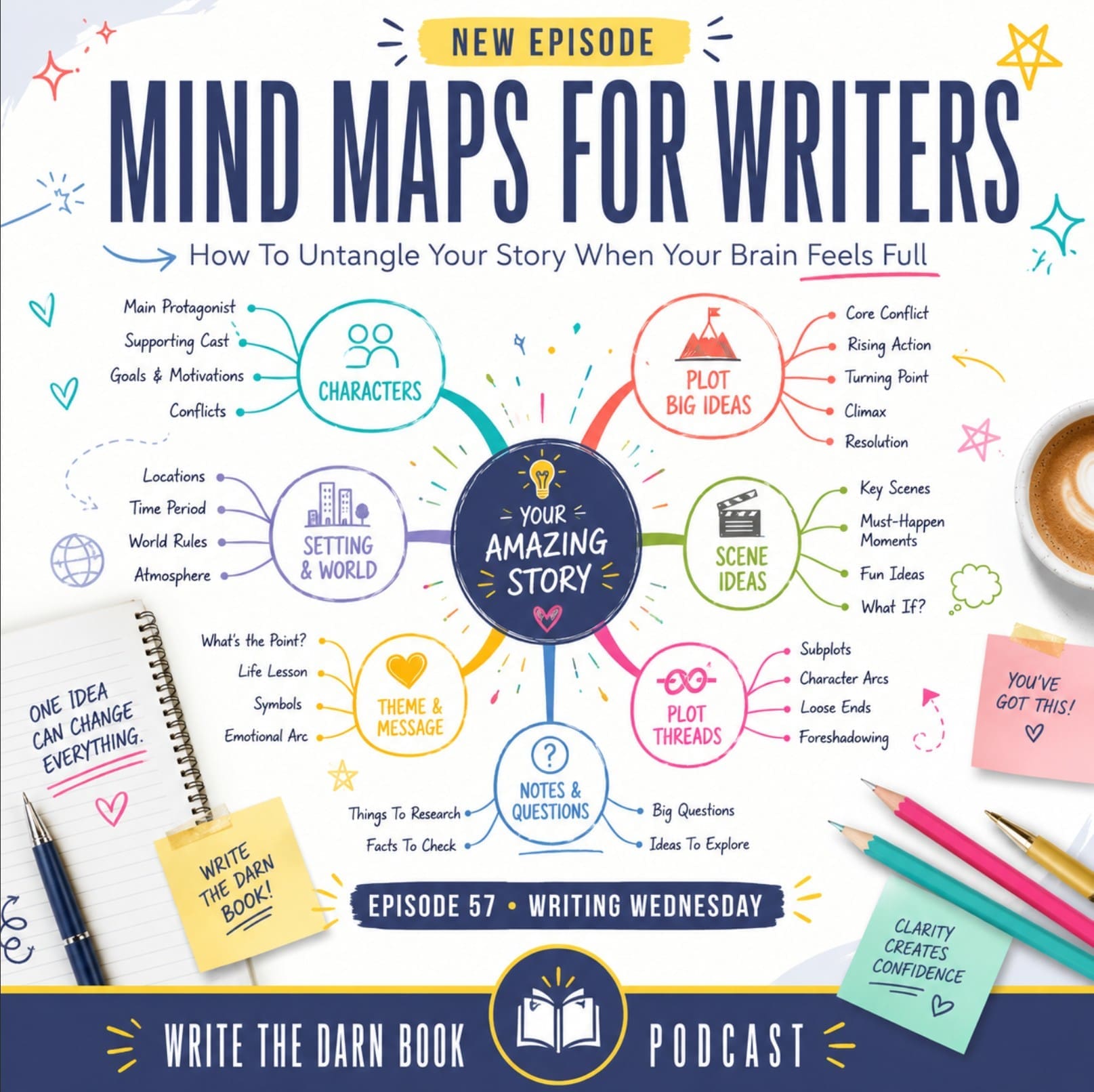

When Your Story Feels Too Full To Hold In Your Head
There is a particular kind of overwhelm that happens when your story becomes too big to hold inside your mind.
You open your laptop. You look at the manuscript. You know there are characters to track, emotional threads to honour, plot points to connect, backstory pieces to reveal, and future scenes waiting somewhere in the fog. Part of you can feel the story is there. It has shape, energy, movement and meaning. But the moment you try to work out what comes next, everything tangles together.
This is where many writers start to think the problem is the story itself. They wonder whether the plot is broken, whether the characters are too complicated, whether they should go back to the beginning, or whether they have taken a wrong turn somewhere.
But often the problem is much simpler than that.
Your brain is trying to hold too many story threads internally at once.
That is where mind maps can be such a powerful tool for writers. A mind map gives your overloaded brain somewhere to place the ideas, questions, connections and possibilities it has been trying to juggle on its own. Instead of forcing yourself to think in a straight line before the story feels ready, you give the story room to breathe on the page.
A Mind Map Is More Than Pretty Circles On Paper
A mind map is a visual thinking tool. It begins with one central idea, question, scene, character, or problem in the middle of the page, then branches outward into connected thoughts. Each branch gives one part of the story somewhere to land.
That matters because stories rarely arrive in tidy order. A character wound may connect to a scene decision. A romantic subplot may affect the external plot. A tiny detail from chapter three may suddenly matter in chapter twenty. A side character may hold the missing emotional key to the protagonist’s arc.
Linear notes can be useful, especially when you already know what you are trying to say. But when your story feels tangled, a list can sometimes make the pressure worse because it asks your brain to organise everything before it has finished discovering what belongs there.
A mind map works differently. It allows one idea to lead to another. It shows relationships. It lets you see the shape of the problem instead of keeping it as a heavy, blurry feeling in your chest.
That is why mind maps can be especially helpful when you are planning a novel, brainstorming book ideas, working through a messy middle, developing character arcs, or trying to understand why a scene feels flat even though the events are technically correct.
The Real Power Of A Story Mind Map
The real power of a story mind map is that it changes the question you are asking.
Instead of asking, “What is the perfect answer?” you ask, “What is connected to this?”
That is a much safer, more creative question for the brain. It reduces the pressure to solve everything immediately and gives you permission to explore. This matters because many writers freeze when they believe the next decision has to be final. The map gives you a place to test possibilities before you commit to one.
For example, if you are stuck on a scene, the problem may seem obvious on the surface. You might think, “I just need to work out what happens next.” But once you start mapping, you may discover the real issue sits beneath the surface. The scene has no emotional shift. The character’s motivation is unclear. The conflict is too soft. The external action is moving, but the inner story is standing still.
A mind map helps you see that without shame. It turns the stuck point into information.
Start With One Clear Question
The most useful mind maps begin with one strong question in the centre of the page.
That question becomes the anchor. It keeps the map focused, especially when your brain wants to chase every possible direction. Instead of writing “My Book” in the centre, which can feel enormous, choose a specific question your mind can actually work with.
You might write: What is this scene really about?
That one question is powerful because it moves you beneath surface action. A scene is rarely just about the visible event. A conversation at a kitchen table may be about betrayal. A kiss may be about trust. An argument may be about grief. A chase scene may be about the character finally choosing courage. When the surface action and the deeper emotional purpose are connected, the scene begins to feel alive again.
Once the question is in the centre, draw three main branches from it.
The first branch asks: What happened before this moment?
This helps you gather the pressure already sitting behind the scene. What did the character just experience? What secret are they carrying? What promise, wound, fear, or unresolved conflict are they bringing into the room?
The second branch asks: What is happening underneath this moment?
This is where the emotional truth of the scene lives. What does the character want? What are they afraid of admitting? What do they need from the other person? What are they protecting? What are they avoiding?
The third branch asks: What needs to change by the end?
A scene needs movement. By the end, something should have shifted. It may be a decision, a revelation, a question, a fracture, a clue, a deeper attraction, a new fear, or a stronger sense of direction. The shift gives the scene its reason to exist.
With those three branches, you have moved from a foggy, overwhelming scene problem into a workable map.
Use Mind Maps When You Cannot See The Next Scene
One of the best times to use a mind map is when you have reached the end of a chapter and cannot see what comes next.
This is a common place for writers to spiral. You may start rereading old chapters, changing the opening again, researching something loosely related, or telling yourself the story has run out of energy. But often, the next scene is already inside the material you have. You simply need a way to draw it forward.
Place this question in the centre of your map: What needs to happen next for the story to keep moving?
Then let the branches gather the three most important sources of information. Look at what has just happened, what your character is emotionally carrying, and what destination the story is moving toward. Somewhere in the relationship between those three pieces, the next scene usually begins to reveal itself.
For a romance writer, that next scene may need to increase emotional intimacy, create friction, or force the characters to confront what they are trying to deny. For a mystery or suspense writer, it may need to complicate the investigation, reveal a clue, or raise the danger. For a non-fiction writer, it may need to move the reader from recognition into understanding, or from understanding into action.
The genre may change, but the principle stays the same. The next piece of writing comes from the relationship between what has happened, what matters emotionally, and where the book is headed.
Mind Maps Help You Separate Threads Without Losing The Whole Story
Many manuscripts become overwhelming because they are carrying several threads at once.
A novel may have an external plot, an emotional arc, a romantic subplot, a mystery thread, a family wound, a villain’s agenda, and a secret from the past. A non-fiction book may have a personal story, a teaching framework, client examples, research, exercises, and reader transformation. No wonder your brain starts to feel full.
A mind map lets you separate those threads while still seeing how they connect.
Imagine you are writing a romantic suspense. In the centre of the page, you might write the title of the book or the key question driving the middle section. From there, one branch could follow the romance arc, another could follow the suspense or mystery thread, and another could follow the protagonist’s inner wound.
Suddenly, instead of one heavy knot, you have three visible threads.
You can then ask better questions. Is the romance developing too quickly for the emotional wound? Is the mystery thread creating enough pressure? Is the character’s inner arc being challenged by the external plot, or are those two pieces running beside each other without touching?
That kind of clarity is hard to access when everything stays inside your head. On the page, you can see it.
Let The Map Be Messy At First
The first version of a mind map is allowed to be messy.
In fact, it probably should be.
A mind map is a thinking tool before it is an organising tool. The early stage is where you let the ideas spill out. Words, fragments, arrows, question marks, half-formed thoughts, scene possibilities, emotional clues, character contradictions, all of it belongs there.
Your job at the beginning is to get the story out of the pressure cooker of your mind and onto the page.
Once it is there, you can begin shaping it. You can circle the strongest idea. You can cross out the branch that feels lifeless. You can draw a line between two pieces that suddenly make sense together. You can notice the one question that keeps tugging at you.
The clarity usually arrives after the mess, not before it.
How Different Writers Can Use Mind Maps
Mind maps are especially useful because they can adapt to different creative wiring.
A Visual writer may naturally gravitate toward colour, arrows, symbols, spatial layout and visual clustering. For this writer, the map may become a picture of the story’s energy. Seeing the shape of the problem can create immediate relief.
An Auditory writer may find the map works best when paired with talking. They may speak each branch aloud, hear the rhythm of the scene, or use the map as a prompt to talk through character dialogue and emotional tension.
A Kinesthetic writer may need the map to feel connected to the body. They may map while standing, walking between sticky notes, or using physical movement to sense which branch feels alive, heavy, blocked, or true.
An Auditory Digital writer may prefer clear labels, logical groupings and precise questions. For this writer, the map works best when it becomes a structured diagnostic tool rather than a free-floating creative sprawl.
The same is true of writing personalities. Dove, Owl, Peacock and Eagle writers may each use a mind map differently, and that is a good thing. These are tendencies rather than fixed boxes, but they can help you choose a mapping style that works with your mind. Doves may map the emotional heart of the scene. Owls may map structure and cause-and-effect. Peacocks may use the map to gather ideas without chasing every shiny possibility. Eagles may use the map to make a clear decision and move forward.
There is no single correct way to mind map. There is only the version that helps you return to the page with more clarity.
A Simple Mind Map To Try Today
Here is a simple map you can use the next time your manuscript feels tangled.
Take a blank piece of paper and write this question in the centre: What is this scene really about?
From there, create three branches. The first branch is what happened before this scene. The second branch is what is happening underneath the scene. The third branch is what needs to change by the end.
Give yourself ten minutes. Keep the words short. Use fragments rather than polished sentences. Let the map be practical, imperfect and alive.
When the ten minutes are over, look back over the page and choose one next action. That might be writing the first line of the scene, changing the point of view, strengthening the conflict, adding a missing emotional beat, or moving the scene to a different place in the manuscript.
The point of the map is movement.
The map has done its job when you know what to write next.
Your Story Is Asking For Space
When your brain feels full, that is often a sign that your story needs more space than your mind can give it internally.
That does not mean your story is broken. It means it is layered. It means there are connections waiting to be seen. It means your creative mind is carrying more than one thread at once, and it is asking for a wider page.
So give it one.
Open your notebook. Draw a circle in the middle. Ask the question that has been sitting beneath the overwhelm. Let the branches come. Let the story show you what belongs together.
You are the vessel for the story, but that does not mean you have to hold every piece of it inside you at once.
Let the words, the questions, the threads and the possibilities flow through you and onto the page.
Listen To Write The Darn Book
For more support with writer’s block, procrastination, creative confidence, story structure, writing tools and finishing your manuscript, listen to the Write The Darn Book podcast with Maddison Michaels.
Listen on Apple Podcasts here: https://podcasts.apple.com/us/podcast/write-the-darn-book-beat-writers-block/id1858775581
And if you would love deeper personalised support to understand how your mind naturally writes, where your resistance patterns show up, and which writing tools will actually work for your creative wiring, you can book a Writing Personality Blueprint Session at maddisonmichaels.com/blueprint.


