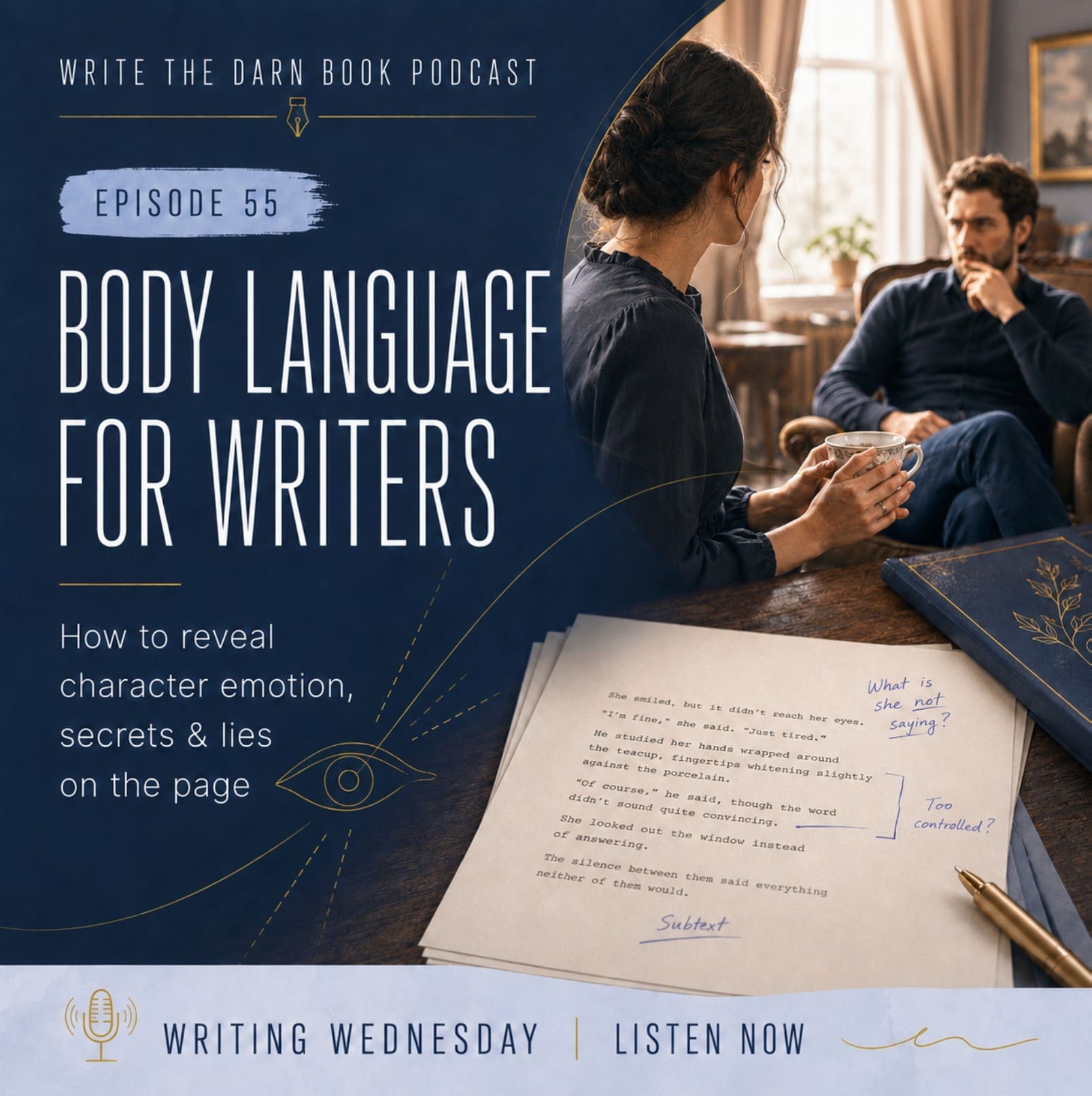

What if your character’s body is already telling the truth before they ever say a word?
Body language is one of the most powerful tools a writer can use, because human beings are always communicating beneath the surface. A character can say, “I’m fine,” while their fingers worry the edge of a napkin. They can smile at the detective while their feet angle toward the door. They can give the correct answer, use the right words, and still reveal fear, guilt, longing, shame, attraction, grief, or calculation through the body.
That is where body language becomes far more than description. It becomes story evidence. It becomes subtext. It becomes tension. It becomes the quiet moment that lets the reader feel something before the character is ready to admit it.
This matters for every writer, but especially if you write mystery, thriller, suspense, romance, historical fiction, fantasy, memoir, or any story where characters are carrying secrets. The body often tells the story before the mouth is ready to.
Why Body Language Is More Than Description
The mistake many writers make with body language is treating it like seasoning. A little jaw clench here. A raised eyebrow there. Someone crosses their arms, glances away, swallows hard, or takes a sip of tea because the dialogue has been running for three pages and someone needs to move.
Those movements can be useful, but only when they mean something. The real craft question is: why is the body doing that in this exact moment?
A character folding their arms means very little on its own. They might be cold. They might be defensive. They might be comforting themselves. They might be mirroring the person across from them. They might simply fold their arms all the time because that is their normal resting posture.
One gesture alone gives you very little. A gesture connected to character, pressure, setting, dialogue, and stakes gives you story. When you start using body language this way, your scenes become more alive because the body is doing real narrative work.
Rather than dropping in physical movement to break up dialogue, start treating body language as behavioural evidence. The body is showing the reader something. Your job is to know what it is showing, why it matters, and what it changes in the scene.
Start With Baseline
Before a behavioural shift can matter, the reader needs some sense of what is normal for that character. Does this character usually move a lot, or are they usually still? Do they hold eye contact, or do they look away while thinking? Do they speak with their hands, or do they keep everything contained? Are they physically warm and expressive, or controlled and economical?
Baseline gives the reader a comparison point. Without baseline, every gesture floats in the scene without weight. Change is only meaningful when the reader has some sense of what has changed from.
Think of a character who is normally expansive. They enter rooms loudly, gesture broadly, touch people on the arm, and laugh with their whole body. Now imagine that same character sitting still at a dining table, hands folded neatly, voice low and careful. That stillness means something because it breaks pattern.
Now imagine the opposite. A character who is usually controlled, formal, and precise suddenly knocks over a glass, speaks too quickly, or reaches for someone without thinking. That movement also means something because it breaks pattern.
This is the first craft question: what is normal for this character, and what changes under pressure? When you answer that, body language becomes character-specific behaviour rather than random movement.
Place Every Gesture Inside Context
A behaviour never lives alone. It lives inside a moment.
A character crossing their arms in a freezing room tells a different story from a character crossing their arms when accused of betrayal. A character looking toward the door during a boring meeting means something different from a character looking toward the door after hearing footsteps in the hall.
Context is where vague body language becomes meaningful body language. It also makes your scene feel more intelligent, because you are asking the reader to interpret behaviour in relationship to the emotional and story pressure around it.
This is especially important when writing fear, deception, attraction, guilt, or grief. The same physical cue can belong to many emotional states. A racing heartbeat can mean panic, desire, rage, anticipation, or illness. A dry mouth can mean fear, grief, thirst, medication, or attraction. A trembling hand can mean terror, age, cold, fury, or suppressed excitement.
So the better question is rarely, “What gesture means nervous?” The stronger question is, “What would this specific character’s body do in this specific scene under this specific pressure?” That question will almost always give you more original writing.
Look for Clusters Rather Than Codes
One cue by itself often means very little. Several connected cues, appearing in response to the same pressure point, create a more convincing pattern.
In fiction, a cluster might look like this: the character answers too quickly, smooths their tie, and angles their body away from the conversation. That combination gives the reader more than one clue. It suggests pressure. It suggests management. It suggests the character is trying to control how they appear.
For a different character, the cluster might be quieter. Their voice goes flat, their hands become very still, and they begin answering in shorter sentences. That might suggest shutdown, calculation, fear, or contained anger, depending on the scene.
The important thing is to avoid turning body language into a simplistic code where every gesture has a fixed meaning. Crossed arms always mean defensiveness. Looking away always means lying. Touching the nose always means deception. That kind of shortcut can flatten the very human complexity you are trying to create.
In real life, we need humility because humans are complex and we can misread them. On the page, you are designing the pattern. You know what the character is hiding. You know what the reader needs to suspect. You know what your point-of-view character notices and what they miss.
That means you can use body language in two directions. You can reveal truth to the reader, or you can misdirect the reader toward the wrong truth. Both are incredibly useful, especially in mystery, thriller, suspense, and romantic suspense.
The guilty person might appear calm because they have rehearsed. The innocent person might appear nervous because they are terrified of being blamed. If your detective assumes nervousness equals guilt, that mistake can become part of the plot. If your reader assumes calm means innocence, that assumption can become your twist.
The clue is real, but the interpretation may be wrong. When that is done well, the reader gets the delicious feeling of looking back later and realising the evidence was there all along.
Use Contradiction to Create Subtext
Contradiction is where subtext lives.
When words and body language match, the scene is clear. A character says, “I’m furious,” and their hand comes down hard on the table. That can work when you want the emotion to land plainly.
But when words and body language disagree, the scene becomes far more interesting. A character says, “I’m perfectly calm,” while carefully placing the glass back on the table with two hands. A witness says, “I don’t remember seeing him,” but their eyes flick for half a second toward the hallway. A wife says, “Of course I believe you,” while she steps back just enough to put the kitchen bench between herself and her husband.
Contradiction creates reader curiosity. It makes the reader ask, “What is really going on here?” As a writer, that question is gold. You want the reader leaning in. You want them noticing. You want them to feel that something is happening under the dialogue, even before they can name it.
That is the heart of showing rather than telling. Showing is more than adding sensory detail. Showing gives the reader evidence they can interpret.
So when you revise a scene, look for moments where your character explains their emotion too directly. “She was scared.” “He felt guilty.” “They were attracted to each other.” Then ask what the body could do to let the reader feel that emotion before the narration explains it.
Instead of “She was scared,” you might write: “She kept her breathing shallow, as if any sound might reach the other side of the door.”
Instead of “He felt guilty,” you might write: “He answered her question while studying the floorboards, his thumb worrying the loose thread at his cuff.”
Instead of “They were attracted to each other,” you might write: “Their hands reached for the same glass, then both withdrew as if the touch had burned.”
Those examples give the reader a body-level experience. They let the reader feel the pressure inside the moment. The reader is invited to notice what the character cannot fully hide.
Let Body Language Change the Scene
This is the step many writers miss. Body language becomes far more powerful when it changes something.
A character notices the tremor in another character’s hand and chooses a softer question. A detective sees a posture shift and circles back to a name. A lover notices the withdrawal and realises the argument is about something deeper. A villain sees fear and presses harder.
Consequence turns body language from description into action. Once you see that body language can move a scene, you stop using it as filler. It becomes part of the engine of the story.
This also affects pacing. A small cue can slow the reader down right before a revelation. A sudden physical shift can quicken the emotional rhythm. A character going still can feel more threatening than a character shouting.
Think about that for a moment. A furious character throwing things is one kind of anger. A furious character becoming perfectly calm, folding a napkin, and speaking in a soft voice can feel far more unsettling. The body language you choose shapes the kind of emotion your reader feels.
That is how body language becomes plot. A tiny physical cue can alter the energy of a scene. It can create suspicion. It can deepen attraction. It can tell the reader a character is grieving before that character can bear to say the word grief aloud.
How Your Creative Wiring Shapes What You Notice
Body language is a beautiful Writing Wednesday topic because it is craft, but it is also creative wiring. The way you naturally process the world affects the kind of physical and emotional detail you are most likely to notice.
Visual writers may naturally see posture, facial expression, spatial distance, and movement in the room. Auditory writers may notice breath, silence, pace, tone, and the change in someone’s voice. Kinesthetic writers may feel the body from the inside, the tight throat, the hot face, the heavy limbs, the pressure behind the ribs. Auditory Digital writers may be especially good at tracking the logic of behaviour, what shifts, what contradicts, and what the pattern reveals.
Each modality brings something valuable to body language. The trick is to use your natural strength first, then deliberately add the layer your scene needs.
If you are Visual, you may write beautiful external detail, and you may also need to ask what the body feels like from the inside. If you are Kinesthetic, you may write emotion powerfully, and you may also need to add what the point-of-view character can actually observe. If you are Auditory, you may catch the rhythm of the room beautifully, and you may also need to anchor it with physical movement. If you are Auditory Digital, you may understand the behavioural pattern clearly, and you may also need to soften the explanation so the reader can infer the truth.
This is one of the reasons writing becomes easier when you understand your wiring. You stop forcing yourself into someone else’s process, and you begin working with the way your mind naturally enters story.
Try This: The Body Language Scene Audit
Choose one scene in your current manuscript where a character is under emotional pressure. It might be an argument, an interrogation, a confession, a romantic near-miss, a family confrontation, or a quiet moment where someone is hiding the truth.
First, identify the character’s baseline. How does this character normally move, speak, take up space, and respond under ordinary pressure? You only need enough clarity to know what a meaningful shift would look like.
Next, identify the pressure point in the scene. This is the moment where something changes. A question lands. A name is mentioned. A truth gets too close. A desire becomes visible. A fear gets touched.
Then revise one paragraph so the body reveals more than the narration explains. Aim for one specific cue, connected to context, with a consequence in the scene. That consequence can be internal, where the point-of-view character understands something, or external, where the other character changes tactics because of what they noticed.
Here is the key: make the body language earn its place. Every gesture should reveal character, increase tension, deepen subtext, or move the scene. Your manuscript deserves stronger than filler.
Listen to Episode 55 of Write The Darn Book
This article is based on Episode 55 of Write The Darn Book, Body Language for Writers: How to Reveal Character Emotion, Secrets and Lies on the Page.
If this helped you see your manuscript differently, listen to the full episode for a deeper walk-through of baseline, context, clusters, contradiction, consequence, and how body language can help you reveal the truth beneath your characters’ dialogue.
Writing Wednesday episodes explore the outer work of writing: craft, structure, revision, publishing, process, and the practical steps that help you finish your book.
⭐️ If this episode resonated with you, I’d be so grateful if you left a five-star review on Apple or Spotify. It helps other writers find the show and reminds them that they are not alone in the messy, magical process of writing a book. 💗
Join the Free Write To Your Wiring Masterclass
If this conversation has lit something up for you, I’d love to invite you to my free masterclass, Write To Your Wiring, happening on Tuesday 30 June at 10:00am Sydney time, live on Zoom.
In this 45-minute masterclass, we’ll look at how your natural NLP modality shapes the way you think, create, access story, and move through resistance at the page.
The way you write body language, dialogue, emotion, structure, and tension is connected to the way your mind naturally processes the world. Some writers see the scene first. Some hear the dialogue. Some feel the emotional truth in their body. Some need the logic and structure to click before the words can flow.
Once you understand that about yourself, writing starts to feel far less like forcing and far more like working with your own creative wiring.
You can save your free spot at maddisonmichaels.com/masterclass.
Your book deserves that kind of support. And you, my friend, are allowed to have support while you write it.
You are the vessel for the story. Let the words flow through you and onto the page.


