
Mindset Monday episodes explore the inner work of writing: blocks, beliefs, identity, resistance, procrastination, perfectionism, and creative flow.
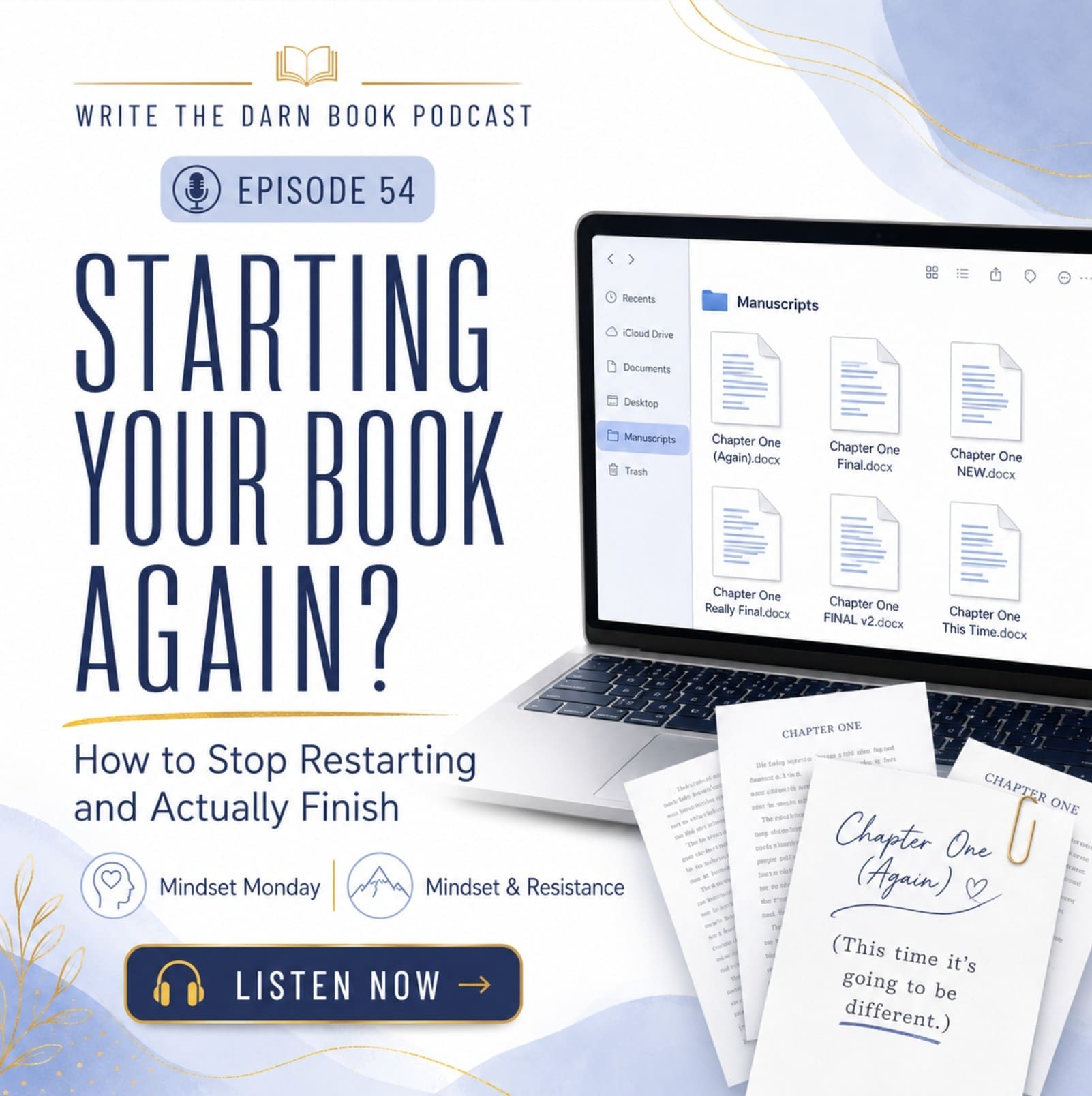
Have you ever opened your laptop, looked in your documents folder, and realised there are six different versions of your manuscript sitting there?
Maybe it’s the same book, started over and over again. Maybe it’s several different manuscripts, each one full of early promise, but paused at the point where the writing began to feel hard. Or maybe you move between projects, telling yourself you’re still writing, while part of you knows you’re avoiding the moment where one manuscript needs your full commitment.
If that feels uncomfortably familiar, you are not broken. You are not lazy. And you are absolutely not the only writer who has found themselves caught in the restart cycle.
Opening a new document, rewriting Chapter One, renaming the project, or chasing a brand new idea can feel productive. It can feel hopeful. It can even feel like the responsible craft decision. Sometimes, it genuinely is. Some manuscripts are practice books. Some ideas need to be parked. Some projects teach you something you needed before the next book could be written.
But when starting again becomes your usual pattern, it is worth pausing and asking a better question than, “What’s wrong with me?”
Ask this instead: “Where do I keep leaving the manuscript, and what does that tell me?”
Why Starting Again Feels So Productive
The beginning of a book has a very particular kind of energy.
The idea is still fresh. The premise still feels full of possibility. The first scene might feel vivid because you have played it over in your mind so many times. You can see the opening image, hear the first line, feel the spark of the story calling you back.
And at the beginning, you have not yet reached the complicated middle. You have not had to deal with the plot hole that needs repairing, the chapter that feels flat, the character who has lost direction, or the emotional scene you are secretly avoiding.
The beginning still feels clean.
The middle asks for commitment.
That is where the restart cycle becomes so convincing. You mistake the energy of beginning for proof that the book is working, and you mistake the discomfort of continuing for proof that the book is broken.
So you open a new file. You rewrite the first chapter. You convince yourself this new version will be the one. Or you move to another manuscript entirely because that one still has the exciting energy of possibility.
In the moment, it feels like progress because you are doing writing-related work. But when the same pattern follows you into every project, the fresh start is no longer solving the problem. It is moving the problem into a cleaner file.
The restart cycle can cost you more than time. It can cost you trust in yourself. Every unfinished draft can become another piece of evidence for the belief that you are someone who starts books but never finishes them.
That belief can become heavier than the manuscript itself.
What Is Really Happening When You Leave the Page
There are several common patterns underneath the urge to restart a book or switch projects, and they often look logical from the outside.
The first is perfectionism disguised as improvement.
This is when you keep returning to the opening chapter because it feels controllable. You can polish the first page. You can adjust the voice. You can refine the hook. That can look like serious craft work, and sometimes it is.
But if you only ever improve the beginning, the rest of the manuscript never has the chance to exist.
The second pattern is fear of finishing.
This one often sounds very sensible. You might tell yourself the book needs more time, the idea needs another rethink, or the outline needs another pass. Sometimes that is true. But sometimes the real issue is that finishing changes the stakes.
A finished draft can be read. It can be assessed. It can be shared. It can be rejected. It can also succeed, which brings its own kind of visibility and pressure.
Starting again keeps the book in a state of potential. The dream stays alive, but the vulnerability of completion stays safely out of reach.
The third pattern is chasing the energy of beginnings.
A new manuscript feels easier because you have not yet had to wrestle with the messy middle. You have not had to sit with the slower, steadier work of developing the book beyond the initial spark.
There is nothing wrong with being a writer full of ideas. That is a gift. But when your writing process depends entirely on the excitement of starting something new, every middle will start to feel boring, messy, or too complicated.
This is where many writers misread the manuscript. They think, “I’ve lost the spark, so this must be the wrong book.”
Sometimes the spark has not disappeared. It has changed form.
It has moved from infatuation into commitment, which is a much quieter place to write from.
Why Your Writing Personality Matters
Different writers often leave manuscripts for different reasons. This is where your writing personality becomes incredibly useful.
When I talk about the Bird Writing Personalities, I am talking about tendencies, not fixed labels. You might be strongly one type, or you might be a blend. Your pattern can also shift depending on the manuscript, the stage of writing, or what else is happening in your life.
A Dove writer often writes from the heart. They are connected to emotion, meaning, and relationship. So when a Dove leaves a manuscript, it may happen at the point where the book starts to feel emotionally exposing. It might be the scene where a character’s pain touches something personal. It might be the chapter that feels vulnerable to write. It might be the moment where the writer starts imagining what readers, family, or other writers will think.
For a Dove, restarting can be a safety response. Page one feels safer because nobody has judged it yet, and the story is still full of possibility. The way back into the manuscript is not to push harder. It is to create emotional safety first. Ask, “What is this scene asking me to feel?” Then remind yourself that a first draft is a private conversation between you and the story.
An Owl writer often leaves when the structure becomes uncertain. The middle starts to feel foggy. The timeline has a wobble. The research feels incomplete. The plot logic has a gap that has not yet been solved.
Because an Owl values doing things properly, uncertainty can feel like a red light. Starting again can sound responsible. It can sound like, “I need to fix the foundation before I keep writing.”
Sometimes the foundation does need attention. But if every structural wobble sends you back to page one, the manuscript never becomes complete enough for you to properly assess it. An Owl usually needs a contained structure check, not a full restart. Map the next section. Identify the next turning point. Clarify what the next chapter needs to do. Then return to the draft.
A Peacock writer often leaves when the energy changes. The beginning feels alive because the characters are new, the idea is shiny, and the possibilities are wide open. But when the manuscript moves into the less glamorous middle, where the book asks for steadiness instead of sparkle, another idea can suddenly look very exciting.
For a Peacock, project-hopping can feel like creativity. Sometimes it is. But if every new idea arrives right when the current manuscript becomes demanding, it is worth asking whether the new spark is an invitation or an escape hatch.
A Peacock’s way back may be to bring aliveness into the existing book. Ask a fresh scene question. Explore a character secret. Change your writing environment. Write in a café, a library, or outside in the sun. The goal is not to flatten your enthusiasm. The goal is to teach your enthusiasm how to stay with the work.
An Eagle writer often leaves when progress slows. Eagles tend to be decisive, focused, and outcome-driven. So when the draft starts feeling inefficient, messy, or below the standard they expected, restarting can feel strategic.
It might sound like, “This version is not strong enough. I can do better if I start fresh.”
But sometimes that decisive energy avoids the slower work the manuscript actually needs. The book might need more emotional depth. It might need patience. It might need you to stay with imperfect pages long enough to find the real shape underneath them.
For an Eagle, the way back into the book is often to redefine progress. Progress is not always speed. Sometimes progress is staying with the scene long enough to find its truth.
When the Manuscript Actually Needs Help
Some restart urges are emotional. Others are connected to genuine craft problems.
You might reach the middle and realise the plot is not working. Your character motivations might be too vague. Your non-fiction chapters might contain strong ideas but lack a clear reader journey. Your structure may need attention.
That kind of problem matters. It deserves support. It may need a stronger map, a cleaner outline, a clearer sequence, or a more defined turning point.
But there is a huge difference between diagnosing the manuscript and abandoning it.
One gives you direction. The other gives you temporary relief.
This is why the Write The Darn Book lens matters so much. We look at the writer and the manuscript together, because a craft problem can trigger a mindset spiral, and a mindset block can make a craft problem feel impossible.
If the plot has lost tension, you do not need to decide you are a terrible writer. You need to identify the specific craft problem. If the chapter structure is messy, you do not need to throw the book away. You need to work out what the manuscript needs next.
Sometimes the manuscript needs craft support.
Sometimes it needs reconnection.
You may have lost contact with the reason this book mattered to you in the first place. That loss of connection can make the book feel cold. You might open the file and feel nothing. You might know the book still has potential, but you cannot feel your way back into it.
When that happens, another project can start looking very appealing, not because it is better, but because it has the emotional charge this manuscript has temporarily lost.
Before you start again, ask what kind of help your manuscript actually needs. Does it need craft support, where the plot, structure, chapter order, or reader journey needs tightening? Or does it need reconnection, where you return to the soul of the book and remember why you wanted to write it?
Sometimes you do not need to begin again.
You need to diagnose what is actually happening, reconnect with what is still alive in the book, and take the next clear step.
The Finish-First Framework
Before you open a fresh document, rewrite the beginning again, or leap into another manuscript, try using what I call the Finish-First Framework.
The first step is to identify your leaving point.
Ask yourself, “Where do I usually leave?” Maybe you leave after the opening chapters, once the first rush of excitement fades. Maybe you leave around the middle, when the book becomes structurally messy. Maybe you leave near the end, when the manuscript feels close enough to be judged.
Your leaving point is information. It shows you where the manuscript, your mindset, or your writing process needs support.
The second step is to name what leaving gives you.
Maybe leaving gives you relief. Maybe it gives control. Maybe it gives distance from vulnerability. Maybe it lets you return to the exciting identity of being a writer with a new idea, rather than a writer facing the messy reality of finishing.
This step is not about judging yourself. It is about honesty. Every pattern gives us something, otherwise we would not keep repeating it.
The third step is to choose the support you need before you decide to restart.
If you are leaving because the story feels emotionally exposing, you may need safety and gentleness before you write the next scene. If you are leaving because the structure feels murky, you may need a simple map for the next three chapters. If you are leaving because the energy has dropped, you may need to bring play back into the current manuscript. If you are leaving because progress feels too slow, you may need to redefine what meaningful progress looks like this week.
This is where the pattern begins to loosen. You are no longer obeying the urge to restart automatically. You are pausing long enough to understand what the urge is trying to give you, and what your manuscript actually needs.
If You Have Several Manuscripts Calling for You
Having many ideas is not the problem. Having no clear decision-making process is where writers often get tangled.
Instead of asking, “Which book am I most excited about today?” ask, “Which book am I most willing to stay with through the hard parts?”
Willingness matters when you are building the identity of a writer who finishes.
You can love a heap of ideas at once. Truly, you can. But finishing usually asks you to choose one manuscript as the active commitment and let the others wait without turning them into escape hatches.
That does not mean you abandon the other books forever. It means you capture the spark, park it somewhere safe, and return to the manuscript you have chosen to finish first.
The act of choosing is powerful. It tells your nervous system, your creative mind, and your writer identity: this is the book I am staying with.
Your Writing Practice for This Week
Choose one manuscript that still feels alive, even if it also feels messy, complicated, or uncomfortable. It can be the book you have restarted several times, or one project among many that keeps asking for your attention.
Open that manuscript and write three short reflections.
Where do I usually leave this project, or projects like it?
What does leaving give me in the moment?
What does my writing personality need so I can continue?
Then choose one small continuing action. Read the last scene and write one paragraph that comes next. Map the next section. Write a letter to the book and ask what it needs from you now.
And when the urge to start again rises, pause before obeying it.
Ask whether starting again is a true creative decision, or whether it is giving you relief from the part of the book that most needs your courage.
That pause is where the pattern begins to change.
A Free Masterclass for Writers Who Want to Understand Their Creative Wiring
If this article is resonating, I’d love to invite you to my free masterclass, Write To Your Wiring, happening on Tuesday 30 June at 10:00am Sydney time.
In this free masterclass, we’ll look at how your natural creative wiring shapes the way you write, process story, experience resistance, and find flow. You’ll begin to understand your NLP writing modality and whether you tend towards Visual, Auditory, Kinesthetic, or Auditory Digital processing.
Because once you understand how your mind naturally works, it becomes so much easier to build a writing process that helps you stay with the book instead of constantly restarting or leaving it altogether.
You can save your free spot here: maddisonmichaels.com/masterclass
Listen to the Full Episode
For the deeper coaching version of this teaching, listen to Episode 54 of Write The Darn Book: Starting Your Book for the Third Time? Here’s How to Stop Starting and Actually Finish.
And if this episode resonated, I’d be so grateful if you followed the podcast and left a five-star review on Apple Podcasts or Spotify. It helps more writers find the show, and it lets them know there is a warm, practical place waiting for them when they are ready to come back to the page. 💗
Your unfinished drafts are not proof that you cannot finish.
They are evidence that you had the courage to begin, the imagination to keep creating, and a pattern that now needs better support.
You are learning how to stay with the manuscript long enough to finish it.
You are the vessel for the story. Let the words flow through you and onto the page.


